VISIT KURTWOODFARMS.COM

Saturday, August 16, 2008

Order is Restored

Dinah has returned.  After seven weeks away from the Farm, she has come back to her home.  In early July I walked Dinah across the Island to a farm that raised Scottish Highland cows and where there was a bull.  I had been trying unsuccessfully for months to get her bred by using artificial insemination.  The timing may have been off and at one point she had ovarian cysts which prevented her from ovulating.  The veterinarian eventually took care of her cysts but she still was not conceiving.  He suggested that I use a 'clean up bull'.  I had never heard this term, but I love it.  The clean up bull is the guy brought in at the end of the game to breed the cows at the dairy that couldn't be bred artificially.  He gets the job done.  
Dinah needed his help and so I found a beautiful Scottish Highland cow nearby.  She lived there through two cycles, the first time spending a lot of time with said bull, when there would have been a second cycle, she paid him no attention:  she had 'settled'.  It is not guaranteed that she was bred, but a good chance of it.  I won't make her pee into a cup, but rather the vet will be out in another month or so to check her out.  
But this isn't really the story here.  The great thing is that she has returned.  Dinah was my first cow and is therefore the Head Cow.  She has the most seniority and rules the herd.  During her absence it was a bit chaotic.  The other bovines seemed aimless, looking for direction and wandering off by themselves. Dinah, a very head strong cow who takes her role seriously, has brought order back to the herd.  She is on top, the rest below her.  When she comes down the pasture to the milking parlor, the rest follow, no stragglers.  I couldn't be happier.  
In a few weeks we will know if she is bred and in mid April, with luck, she will calve.  The good news would be she would come into milk again and be a part of the milking here again after a long absence, the bad news, if her calf is a heiffer, the chance of  it being raised up to be a milker is small.  The young female would be half Jersey and half Scottish Highland -- a odd combination for a milker.  A young bull calf, however, would be ideal:  the best of meat and dairy to be slaughtered after a year for meat for the Farm.  We shall see.

Monday, August 11, 2008

My Three Daughters

I am presently milking three cows here at the Farm:  Francesca, Boo and Lily.  They are my three daughters.  I don't expect to have children at this point in my life, so these three will have to suffice as my progeny at least for the summer.  
They are all very different.  Francesca is the first to be milked every morning and every afternoon.  The most senior cow in milk while Dinah is dry.  Once Dinah calves next spring and comes back into milk, she will take over as the first cow to be milked.

Francesca is strong, opinionated and confident.  She is aware of her status here and does not question it in any way;  she knows that she deserves to be most senior cow.

Boo is the prettiest cow in the bunch.  Beautiful thin legs with black markings, a slender youthful body, and a graceful if slightly lopsided utter.  She rarely mixes with the other bovines
but rather leads her life solo.  I hate to admit it, but I think she is not the brightest one of the herd, but her looks carry her far.

Lily is the newest addition to the herd. A bit older and a bit more tired, but an amazing producer of lovely milk.  She is truly confused each morning and afternoon that she is not the first cow out of the gate and into the milking parlor. Truly confused.  Each time.  Wise, presumptive, bossy, bright.

The point here is not that the cows of Kurtwood Farms are different, but that they have personalities;  unique personalities.  The fact that I can even call it a personality confirms to me that they have a presence.  Can we call them sentient creatures?  As they are at this point in their lives milking cows, I embrace their personalities.  When their careers as milkers ends and they are slaughtered for their meat,  are their personalities reasons for not slaughtering them?

As most of the ground beef sold in the U.S. at large restaurants comes from former milking cows, most if not all of us have participated in this question.  

Something to ponder today;  no answer for you as yet.

Friday, August 1, 2008

A New Look at a Farm Boy

I sat down during lunch today to read over the New York Times. I tend to cheat quite a bit at reading the Times. What the paper chooses as its highlighted articles I read and then I tend to always hit the most emailed articles. This is always an odd selection: never about the war in Iraq, but rather personal health, money management and the home decorating story. This is what America reads, or at least what readers of the New York Times read.

The article that hit me today was Nicholas D. Kristof ' A Farm Boy Reflects'.

http://www.nytimes.com/2008/07/31/opinion/31kristof.html?em

The title intrigued me enough to check it out. Essentially he writes that animal rights in the form of improved conditions for farm animals is gaining ground around the world. His experience growing up on a farm taught him that animals have personalities and are closer to humans than we think. Even so, he continues to enjoy eating meat.

On the surface this sounds nice. It tends to make everyone feel good about themselves. You still get to eat meat. You can enjoy it and take pleasure in it. Legislation around the country advancing the living conditions of farm animals is a good thing. Everyone is happy.

I have a distinct problem with it. Kristof talks about how his family raised geese, would slaughter them one by one and how it was a sad thing as the remaining goose-mate would cry and holler as its mate was being decapitated. This lead his family to donate the remaining geese to the local park because they were incapable of continuing this practice.

The problem is that he has fallen into the classic city view of farm animals: that they are pets that are murdered. In no way was this man a 'farm boy' as a child. The geese are not humans and should not be given charactoristics that are more aplicable to your aunt Lois. We have entered into a social contract -- we slaughter meat for our nutrition, the animals loose in this deal, we benefit. The animals in question certainly have a presence; they look at us and come to us when we feed them, but to put emotions on them, to me is ludicrous.

If our only contact with animals is our house pets -- dogs and cats, than we would naturally assume cows, pigs, sheep and geese to be similar. The contract is, however, different. Household pets live with us, there have been domesticated and there is no untimely slaughter for them. We keep them for their companionship and not for their protein. We develop an emotional bond with our dogs and cats.

Kristof has confused these two contracts; he and his family created a bond with the family geese. It was admirable, but they ceased to be farm animals at that point. His family realized it and released them from their bonds.

My recommendation is to treat farm animals as such. They should of course be well raised: properly housed, properly fed and properly slaughtered. There is no expectation that they will not be slaughtered for their meat. To think of them as large pets that live on farms is folly, especially while one is chewing on a big hunk of steak as they pontificate about the rights of animals.


Friday, July 25, 2008

The Real Deal

Work is progressing on the cow barn every day.  The main structure is fully erected, the rafters are up and now they are starting on the skip sheathing.  It is exciting to watch, but what is most interesting is not the building itself but the man who is building it.  I want to share him with people.
The carpenter who designed and is building this barn is Frederic Brillant.  He is a Frenchman who has lived on the Island for twenty years.  Trained in France he now works on Vashon.  When I asked him how he got here, his answer was: "she had red hair."   You have to read that with a really heavy French accent to get the full weight of it.
I often think that I have a simple life;  the calm country life that you dream of while slogging away at the office. And then I come to my senses.  I write a blog, I never have my iPhone more than a foot away from me, and I read the New York Times on line daily.  It is really rather difficult to resist modern life.  Once you begin to take part in the the trappings of being a citizen of the 21st century, you are hooked into the whole culture.
Frederic, however, has managed to resist.  I truly don't know how he does it.  He has no cell phone, no computer that I have ever seen.  He draws his building plans with a pencil and paper, no CAD.  Most of his wood working tools he made by hand and are non-electric.  I did see him out one night in a Hawaiian shirt, but I think that was an aberration.
He constructs buildings very very close to the way they were built in France three hundred years ago.  He seems to live that life as well.  He has a small electric stove, but I have seen him cooking more often over a wood stove at his large wood shop on the Island.  If it was a schtick I would discount it entirely, but it is genuine.  He sees the integrity and the beauty in the old ways and hold true to those ideals.
The result for me is an amazing barn.  It is made by hand, held together with locust pegs and a few spikes on the roof rafters.  It will stand far longer than myself.  I have spent hours walking around it, staring at each piece, handling the posts and beams and purloins and rafters.  I try to imagine this farm in a hundred years time, the modern world getting closer and closer each decade, but this barn remaining.
I wish I could take credit for this structure, but it is all Frederic's doing.  He designed it and built it, my only task is to steward it through my time here at the farm.    

Monday, July 21, 2008

Nouveau Riches

Yesterday afternoon I went out to the berry patch and began to pick some alpine strawberries for dessert last night.  The alpines are small berries, both white and red, that are very tasty, yet very, very small.  I enjoy them immensely.  It took not all afternoon by any means, but certainly quite a few minutes to pick a tight little bowl of the fragrant berries. 

As I was hunched down trying to concentrate on the small jewels, I thought back to the day I bought the plants.  The nursery-woman remarked that Thomas Jefferson enjoyed a bowl full of them for breakfast often.  As I have never seen alpine strawberries sold in the farmers markets much less in the grocery store, growing them yourself and having someone pick them for you is your best option.  This makes them all the more precious.
As it took very little of my brain to pick I had quite a bit of capacity left to ponder the present state of our culture.  What I came up with was a great sadness, that the sign of great success and great wealth in our country is no longer a bowl of alpine strawberries grown for you and picked for you and placed before you in a lovely bowl at your breakfast table, but rather a fast car.  
This is sad to me as a bowl of fresh berries is the ultimate luxury; the ne plus ultra that few could attain, yet all would desire.  Possibly our present housing slump / recession / banking crisis could have been avoided had the Thomas Jeffersons of our day been planting berries on their estates and not sowing the seeds of financial largesse. 
The best part of the  alpine luxury vision is that the mere mortals of the world such as ourselves could cheat a bit up the social ladder by planting such berries and picking them ourselves.   Not the same as having the manservant bring them to us on a silver salver, but enjoyable for sure.

I recommend a bowl when you can find them.  Few things in life can match them for flavor and for the unmatched scent of fresh berries.  A fast car is pretty fun too though.

Saturday, July 19, 2008

Trip to Stud Town

Dinah is on a great vacation.  She is the Head Cow here at Kurtwood Farms;  most senior milker.  She came in service four years ago this coming September, the beginning of the dairy business.
A beautiful cow, full of personality and one who takes her role and responsibility as Head Cow terribly seriously, she has always been my favorite.  Unfortunately she has had a health problem for the past year.  She was dried up to give her a break, and at the time she was not yet bred.  I anticipated breeding her soon after she stopped milking and she would calve nine months later.  After numerous failed attempts, I had her checked out by the large animal veteranian on the Island, who diagnosed her with ovarian cysts.  
Numerous hormone treatments were tried, some succesful, others not so much. I still was unable to get her pregnent.  The vet recommended a bull to breed her instead of the aritificial insemination I had been using.  A friend nearby had a bull and offered to have her stay there for the month.  And so, Dinah is on a vacation of sorts.
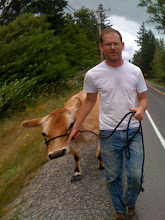
Harm Cord zum Spreckel's farm is not that far from Kurtwood Farms, but it is a trek -- maybe a couple of miles.  Originally I had planned to hire a truck and trailer to transport her there, but came to my senses and decided to walk her their myself.  
Together Dinah and I set off from the farm on our journey.  She was quite excited to be headed out and pulled me along as we headed to the road.  A bold bovine, she found the road exciting.
We marched along with cars slowing down all along the way.  I am by nature a shy guy in public, so people gawking at me is not truely in my comfort zone, but Dinah is a natural crowd pleasure and I rose to the occasion.
A short ways into the trek a trucked pulled over and as luck would have it a great friend hopped out and joined me for the journey.  It was a great time to chat and catch up, Dinah turning heads the whole way.  The fun thing was that for the people of Vashon Island, a stunning Jersey cow walking down the highway was a great sight to see.  It made everyone happy; a little extra treat that they could tell their families when they got home.  I was pleased to be a part of that.
Dinah made it to her destination:  a beautiful farm with Scottish Highland cows and a very eager bull. With a bit of luck, the deed will be done and we will have a calf next year.  The best part of it is that I get to go and fetch her in two weeks and walk her back to Kurtwood, meeting people along the way; making people smile as they drive past.

Thursday, July 17, 2008

The Barn Raising

The barn raising has begun.  This project was started months ago with the idea that the cows needed a place to go during the winter months and that better storage was needed for the hay and grain.  This morning the timbers were raised for the most beautiful cow barn on the Island.
Frederic Brillant is building the barn;  he also built the roof of the kitchen building and the roof over the wood fired oven.  It is a timber frame barn made entirely of Douglas fir held together with locust wood pegs.  
Frederic creates the structure in his wood shop on the west side of the Island and then loads up the sticks and drives them over to the farm.  In the space one day he will erect the main part of the barn.  I expect the roof beams will go up tomorrow.  It is so quick and precise that it appears to be very simple.  Upon closer examination each stick is complicated, different mortises, different tenons on each.  Unusual markings identify the different sticks.  Although I have spent three years looking at the marks on the kitchen roof, I still haven't deciphered them.  I could ask him to explain them, but fear it is actually rather simple.  I enjoy the mystery.
The timelessness of this project excites me.  Although a large cement truck arrived a couple of weeks ago to pour the footings, the process of building this barn probably hasn't changed much in a couple of hundred years.  Some of Frederic's tools in his shop are electrically driven, but many are beautiful hand tools.  If I squint just so on this beautiful sunny day it is the nineteenth century in rural France.  I have also have had fantasies today of what this farm will look like one hundred years hence when the world around it has changed dramatically, but where it is possible that this barn stands, exactly as it was built.
I have had other construction projects over the years.  Most follow a fairly similar pattern.  The crew is usually young guys, ClassicRock blaring from their trucks;  they throw their garbage by the side of the job site and find any question from me an affront.  Here today are two Frenchmen, yammering on in their native tongue.  They are well dressed and concentrate on the task at hand.  No music blares, no refuse remains and my questions provide them with the seed of an interesting story on the history of French building.  
Soon the barn will be finished and the cows will move in.  Seems a bit odd for these gentle bovines to get the best spot on the farm, but they tend to work harder than I, day in and day out.