VISIT KURTWOODFARMS.COM

Monday, July 21, 2008

Nouveau Riches

Yesterday afternoon I went out to the berry patch and began to pick some alpine strawberries for dessert last night.  The alpines are small berries, both white and red, that are very tasty, yet very, very small.  I enjoy them immensely.  It took not all afternoon by any means, but certainly quite a few minutes to pick a tight little bowl of the fragrant berries. 

As I was hunched down trying to concentrate on the small jewels, I thought back to the day I bought the plants.  The nursery-woman remarked that Thomas Jefferson enjoyed a bowl full of them for breakfast often.  As I have never seen alpine strawberries sold in the farmers markets much less in the grocery store, growing them yourself and having someone pick them for you is your best option.  This makes them all the more precious.
As it took very little of my brain to pick I had quite a bit of capacity left to ponder the present state of our culture.  What I came up with was a great sadness, that the sign of great success and great wealth in our country is no longer a bowl of alpine strawberries grown for you and picked for you and placed before you in a lovely bowl at your breakfast table, but rather a fast car.  
This is sad to me as a bowl of fresh berries is the ultimate luxury; the ne plus ultra that few could attain, yet all would desire.  Possibly our present housing slump / recession / banking crisis could have been avoided had the Thomas Jeffersons of our day been planting berries on their estates and not sowing the seeds of financial largesse. 
The best part of the  alpine luxury vision is that the mere mortals of the world such as ourselves could cheat a bit up the social ladder by planting such berries and picking them ourselves.   Not the same as having the manservant bring them to us on a silver salver, but enjoyable for sure.

I recommend a bowl when you can find them.  Few things in life can match them for flavor and for the unmatched scent of fresh berries.  A fast car is pretty fun too though.

Saturday, July 19, 2008

Trip to Stud Town

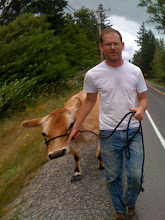
Dinah is on a great vacation.  She is the Head Cow here at Kurtwood Farms;  most senior milker.  She came in service four years ago this coming September, the beginning of the dairy business.
A beautiful cow, full of personality and one who takes her role and responsibility as Head Cow terribly seriously, she has always been my favorite.  Unfortunately she has had a health problem for the past year.  She was dried up to give her a break, and at the time she was not yet bred.  I anticipated breeding her soon after she stopped milking and she would calve nine months later.  After numerous failed attempts, I had her checked out by the large animal veteranian on the Island, who diagnosed her with ovarian cysts.  
Numerous hormone treatments were tried, some succesful, others not so much. I still was unable to get her pregnent.  The vet recommended a bull to breed her instead of the aritificial insemination I had been using.  A friend nearby had a bull and offered to have her stay there for the month.  And so, Dinah is on a vacation of sorts.
Harm Cord zum Spreckel's farm is not that far from Kurtwood Farms, but it is a trek -- maybe a couple of miles.  Originally I had planned to hire a truck and trailer to transport her there, but came to my senses and decided to walk her their myself.  
Together Dinah and I set off from the farm on our journey.  She was quite excited to be headed out and pulled me along as we headed to the road.  A bold bovine, she found the road exciting.
We marched along with cars slowing down all along the way.  I am by nature a shy guy in public, so people gawking at me is not truely in my comfort zone, but Dinah is a natural crowd pleasure and I rose to the occasion.
A short ways into the trek a trucked pulled over and as luck would have it a great friend hopped out and joined me for the journey.  It was a great time to chat and catch up, Dinah turning heads the whole way.  The fun thing was that for the people of Vashon Island, a stunning Jersey cow walking down the highway was a great sight to see.  It made everyone happy; a little extra treat that they could tell their families when they got home.  I was pleased to be a part of that.
Dinah made it to her destination:  a beautiful farm with Scottish Highland cows and a very eager bull. With a bit of luck, the deed will be done and we will have a calf next year.  The best part of it is that I get to go and fetch her in two weeks and walk her back to Kurtwood, meeting people along the way; making people smile as they drive past.

Thursday, July 17, 2008

The Barn Raising

The barn raising has begun.  This project was started months ago with the idea that the cows needed a place to go during the winter months and that better storage was needed for the hay and grain.  This morning the timbers were raised for the most beautiful cow barn on the Island.
Frederic Brillant is building the barn;  he also built the roof of the kitchen building and the roof over the wood fired oven.  It is a timber frame barn made entirely of Douglas fir held together with locust wood pegs.  
Frederic creates the structure in his wood shop on the west side of the Island and then loads up the sticks and drives them over to the farm.  In the space one day he will erect the main part of the barn.  I expect the roof beams will go up tomorrow.  It is so quick and precise that it appears to be very simple.  Upon closer examination each stick is complicated, different mortises, different tenons on each.  Unusual markings identify the different sticks.  Although I have spent three years looking at the marks on the kitchen roof, I still haven't deciphered them.  I could ask him to explain them, but fear it is actually rather simple.  I enjoy the mystery.
The timelessness of this project excites me.  Although a large cement truck arrived a couple of weeks ago to pour the footings, the process of building this barn probably hasn't changed much in a couple of hundred years.  Some of Frederic's tools in his shop are electrically driven, but many are beautiful hand tools.  If I squint just so on this beautiful sunny day it is the nineteenth century in rural France.  I have also have had fantasies today of what this farm will look like one hundred years hence when the world around it has changed dramatically, but where it is possible that this barn stands, exactly as it was built.
I have had other construction projects over the years.  Most follow a fairly similar pattern.  The crew is usually young guys, ClassicRock blaring from their trucks;  they throw their garbage by the side of the job site and find any question from me an affront.  Here today are two Frenchmen, yammering on in their native tongue.  They are well dressed and concentrate on the task at hand.  No music blares, no refuse remains and my questions provide them with the seed of an interesting story on the history of French building.  
Soon the barn will be finished and the cows will move in.  Seems a bit odd for these gentle bovines to get the best spot on the farm, but they tend to work harder than I, day in and day out.

Tuesday, July 15, 2008

Kurtwood Farms: An Update

    Last week I was away from the farm for a short vacation.  My first extended time off since the first cow arrived here four years ago.  As much as I love it here, cherish my animals and never want to leave, it was great to be away.   
    It is also great to be back.
    The seasons have flipped while I was off the Island. When I left the cows were grazing on verdant, albeit short pasture, the warm weather vegetables were in the ground but just relaxing and the raspberries were small, rigid lumps.  All has changed.  The pastures really cannot be termed pastures at this time. Maybe dusty weed patches with the odd green patch.  The cows have switched to alfalfa hay brought in from Eastern Washington now and will continue till the rains return in a few weeks.
The tomatoes, squash, beans and corn have all shot up miraculously.  Little starts a couple of weeks ago are now full fledged plants, ready to fruit.  The raspberries are ripe for the picking and delightful.
    It is odd that I spend most of my time in the trees rarely seeing the forest.  I really thought nothing was growing; that the pigs were permanently small, the hens stuck in adolescence. After a week of absence you come back and see the forest for what it is:  a dynamic place, full of change and growth.
    This is also the time of year when I start to cut my losses and focuses on my best bets.  In the winter and spring everything in possible.  Grandiose plans of cultivating every inch of ground for a variety of crops make perfect sense in May.  The ground is moist, the weeds haven't come up and the weather is blissfully mild.  By this time of year, late July, everything has changed. Weeds have taken over some sections so entirely that they must be abandoned.  What was easy to manage when it is 65' out is a chore and impossible when it is 90'.  I would love to chat about how everything is perfect, but the reality is that sometimes the weeds win, the heat of the day wilts the fragile plants.  
    
    The good news is that work on the cow barn continues.  The foundation has been poured, the footings set.  The sidewalks connecting the milking parlor and the barn ready to go.  Soon Frederic will arrive and begin the process of assembling the timber frame that will make up the structure of the barn.  


Saturday, June 21, 2008

The Equinox

    The summer equinox has arrived here at Kurtwood Farms.  Actually it has arrived everywhere in this hemisphere, but I am enjoying it here at the farm. The weather is perfect, sun shining, warm yet not too hot and there is the distinct feeling that the sunlight will never ebb.  
    The contractors have finished for the day, the workmen gone home.  The animals have been fed and watered, the cows milked.  The milking parlor has been scrubbed down and the evening milk is cooling is the chiller. Surprisingly no neighbors are running lawnmowers to disturb the calm. All is right with the world.  
    Dinner this evening was divine and of this place, this terroir.  A tranche off a beef rib eye, with a bit of fat on the edge, aged for two weeks.  This was from the last calf slaughtered:  Bruno, a beautiful calf, the son of Dinah, head cow at Kurtwood Farms.  The meat had hung for 14 days before being frozen to dry a bit and concentrate its flavors.  I savor those flavors this evening, weeks later.
    The steak was sauted on a hot steel pan with a bit of pork fat.  It sputtered and popped and browned to the surface of the steel.  I flipped it, seared the other side and left it to finish cooking on the heat.  The smell of the beef filled the smokey room.
   When the steak had the feel and give of a medium rare steak --  saignant, I moved it to my waiting plate to rest.  None of that cover it with a sheet of foil stuff, I wanted to see it as I finished the sauce.  A few onions went onto the steel pan to add a bit of bite and then a splash of red wine to deglaze and pull those crunchy bits form the pan.  A big lump of beef jelly from the cooler sputtered as it melted on the heat.  The onions cooked, the stock melted and the sauce began to reduce.  A lump of golden Jersey butter finished out the sauce giving it a shine and a luxury that the steak deserved.
    The juices from the waiting steak went back into the pan, a final swirl and the sauce graced the large white plate.  Cracks of black pepper added some bite to the pretty plate.  No prissy garnish, no chopped herbs to mess it, just the brown earthy sauce and the crusty brown beef.
    The sun had begun its slow descent by this time to the horizon.  The dogs huddled at my feet expecting a piece of beef that would never come.  Each bite was savored.  Nothing was wasted, all was enjoyed, a scrap of bread licking the sauce left on the plate.
    A bowl of rhubarb finished the meal, sweetened a bit but holding onto its sour roots.  The red color was disarming, nothing cherry like about this rhubarb.  Its classification as a vegetable got me off the hook for not having a salad or a branch of broccoli in sight in spite of a garden filled with greenery a few steps from the kitchen door.
    Not a very summery meal on this high holiday of summer.  But is was a great meal, one to savor bite by bite while reflecting on the year that has been as we peak and slide down the other side of June.  

Wednesday, June 18, 2008

The Barn Begins

    Here at Kurtwood Farms, the landscape is changing.  Today the contractor began work on the foundation for the new cow barn.  Months ago I decided that a barn for the cows would be a good thing and mentioned it to Frederic Brillant, the local Island French timber framer.  After many discussions about bovine needs and characteristics he came up with a plan.  A simple open barn just to keep the ladies out of the rain during the winter and a room for hay and grain and a simple stall for calving.  
The plans were routed through an assortment of King County offices, making a lot of beaurocrats happy to put their stamp of approval on them.  I am pleased to announce that it will not be built on a septic system, nor on a wetland, nor on th e property line, nor compromise my historic home.  
For the past four years my cows have spent their winters outside in the weather.  In the worst nights of storm and rain they would move to the woods and point their heads into the bushes. It made me crazy.  I would spend the night worrying about them, yet never knowing really what to do.  Or even really knowing if it bothered them.  They would get wet certainly, but was that okay?  They never really seemed sick or upset and always marched into the milking partlor the next morning and gave a respectable amount of milk.
I asked a friend of mine who had grown up on a dairy farm what he thought -- did I really need a barn for them?  His reply was perfect:  'the barn is for you;  if it makes you worry less then build it, the cows will be fine.'  
And so it has begun.  The foundation will be poured later in the week and then Frederic will begin to assemble the timbers that will be the structure of the barn.  Updates to follow.

Tuesday, June 17, 2008

Stray Voltage -- Who Knew?


For four years now I have had dairy cows here at the farm.  Over the course of tending to them and milking them twice daily during those many seasons, I feel that I have amassed a  fair amount of bovine experience.  I certainly am aware of my shortcomings but at least I knew where they were.  I was humbled this week by a bizarre cow problem.
The dairy building is a small concrete building that I had built three years ago to chill the milk, store it, bottle it and to hold the dairy equipment.  On one side of it is a small portico that the cows pass through on their way to the milking parlor adjacent to the dairy.  It is a concrete slab that is integral to the milk house and covered by a metal roof.
This past wet, rainy week one of the cows came up to the porch, had two of her hoofs on the muddy ground and two on the concrete slab.  Immediately she began to buckle and writhe.  I thought she had something stuck in one of her hoofs at first and proceeded to encourage her to continue through the porch so I could check it out. She continued to dance across the concrete appearing at this point to be having a heart attack if cows can have such a condition.  
It was frightening and fascinating all at the same time.  Once she passed over the concrete and onto the sidewalk leading into the milking parlor it appeared to cease.  The next cow, however, appeared to have the same problem minutes later.  At this point it was apparent that it was not a condition that one cows was afflicted by, but rather an environmental issue.
At the same time as the bovine-concrete revulsion, the large blast chiller that cools the milk began having odd problems;  blowing circuits and shutting down at the end of its cycle.  I surmised an electrical problem in the milk house.
My local friendly electrician Jason was called and informed of this bizarre occurrence. I expected him to tell me that he felt I was insane, but even if he felt that way, he kept it to himself and arrived that afternoon to investigate.  As there are few dairies on this suburban island, his expertise was more in wiring media rooms for the latest flat screen TV than in hooking up dairy barns. Luckily he is a curious guy and made some calls, brought out a voltage meter and began poking around.
As it happens there is an entire part of the Electrical Code that deals with dairy barns.  Cows, I know now, are extremely sensitive to, among other things, stray voltage.  They have the ability to pick up a half of a volt of electricity as it flows through a slab of concrete.  At one stray volt cows can get so disturbed as to dry up and cease producing milk.  We were getting readings of as much as two volts off of the metal roof and galvanized downspouts that connect to the concrete pad.  Maybe it was my thick rubber boots, but on my hands and knees I was unable to detect anything on this seemingly dull, un-pulsing concrete slab.  
Jason hooked up a few grounding wires, made plans to sink a few deep grounding rods, but mostly we just looked for ways to keep the cows away from the building.  Luckily cows other great qualities are the ability to never forget anything and to revel in routine.  The next morning after the great shocking trek to milking, neither Boo nor Francesca had any interest in coming near the milk house.  They appear very docile and loving, but 850 pounds of bovine anchored into the ground with pointed hoofs is no match for my slender frame attempting to pull them.
The cows have found a new path to milking that they are happy with, Jason is reading up on the electrical dairy protocol and I have another notch on my dairyman's belt.