VISIT KURTWOODFARMS.COM

Tuesday, June 17, 2008

Stray Voltage -- Who Knew?


For four years now I have had dairy cows here at the farm.  Over the course of tending to them and milking them twice daily during those many seasons, I feel that I have amassed a  fair amount of bovine experience.  I certainly am aware of my shortcomings but at least I knew where they were.  I was humbled this week by a bizarre cow problem.
The dairy building is a small concrete building that I had built three years ago to chill the milk, store it, bottle it and to hold the dairy equipment.  On one side of it is a small portico that the cows pass through on their way to the milking parlor adjacent to the dairy.  It is a concrete slab that is integral to the milk house and covered by a metal roof.
This past wet, rainy week one of the cows came up to the porch, had two of her hoofs on the muddy ground and two on the concrete slab.  Immediately she began to buckle and writhe.  I thought she had something stuck in one of her hoofs at first and proceeded to encourage her to continue through the porch so I could check it out. She continued to dance across the concrete appearing at this point to be having a heart attack if cows can have such a condition.  
It was frightening and fascinating all at the same time.  Once she passed over the concrete and onto the sidewalk leading into the milking parlor it appeared to cease.  The next cow, however, appeared to have the same problem minutes later.  At this point it was apparent that it was not a condition that one cows was afflicted by, but rather an environmental issue.
At the same time as the bovine-concrete revulsion, the large blast chiller that cools the milk began having odd problems;  blowing circuits and shutting down at the end of its cycle.  I surmised an electrical problem in the milk house.
My local friendly electrician Jason was called and informed of this bizarre occurrence. I expected him to tell me that he felt I was insane, but even if he felt that way, he kept it to himself and arrived that afternoon to investigate.  As there are few dairies on this suburban island, his expertise was more in wiring media rooms for the latest flat screen TV than in hooking up dairy barns. Luckily he is a curious guy and made some calls, brought out a voltage meter and began poking around.
As it happens there is an entire part of the Electrical Code that deals with dairy barns.  Cows, I know now, are extremely sensitive to, among other things, stray voltage.  They have the ability to pick up a half of a volt of electricity as it flows through a slab of concrete.  At one stray volt cows can get so disturbed as to dry up and cease producing milk.  We were getting readings of as much as two volts off of the metal roof and galvanized downspouts that connect to the concrete pad.  Maybe it was my thick rubber boots, but on my hands and knees I was unable to detect anything on this seemingly dull, un-pulsing concrete slab.  
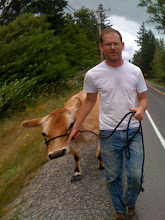
Jason hooked up a few grounding wires, made plans to sink a few deep grounding rods, but mostly we just looked for ways to keep the cows away from the building.  Luckily cows other great qualities are the ability to never forget anything and to revel in routine.  The next morning after the great shocking trek to milking, neither Boo nor Francesca had any interest in coming near the milk house.  They appear very docile and loving, but 850 pounds of bovine anchored into the ground with pointed hoofs is no match for my slender frame attempting to pull them.
The cows have found a new path to milking that they are happy with, Jason is reading up on the electrical dairy protocol and I have another notch on my dairyman's belt.  

Monday, June 16, 2008

Chicken Tractor De Luxe


Kurtwood Farms has a new addition: a shiny new chicken tractor.  Shipped in from points east and assembled at great frustration over a number of hours on Saturday, it is now home to 25 content hens.

The basic concept of the Chicken Tractor is thus:  a secure bottomless box, filled with chickens, is moved daily to a new patch of pasture.  In the process the birds feast on the bugs and detritus of the pastures cow manure and fresh grass.  As the community moves often, there is never the build up of chicken manure or the problems associated with such deposits and 
only the benefits of fertilizing the pastures.

Joel Salatin of PolyFace farm in Virginia coined this term and probably the concept as well.  The problem has always been trying to make a box that is secure from racoons on the ground and hawks in the air that together can decimate a flock of birds in a matter of days.  A home made tractor tends to be top heavy and just plain too heavy to move daily. High winds will blow the contraption over sending birds scurrying in all directions in the middle of a storm.

The solution here is a commercially produced chicken tractor.  Made of sheet aluminum and quite well designed.  Heavy from the insane number of little nuts and bolts and washers, yet low enough to the ground the keep it tight in spite of potentially inclimate weather. 

By day two I am still quite optimistic.  The cows were most curious of the shiny foreign object in their pasture but moved on after a few minutes of sniffing it out.  Large slicks of cow slobber dulled it up a bit however.

My nightmare was of coming back in the afternoon to find the grass littered with twisted bits of aluminum sheets, chickens all asunder and some very smug bovines.  As it happened, the first day went off without a problem.   Racoons may still find some clever way to reach under and grab the docile birds sleeping through the night, but I am hopeful they will give up quickly and move on to other options of feeding themselves.

This tractor is filled with young egg laying hens.  If successful another chick coop on wheels will be ordered and inhabited with meat birds.  The idea of a pan of golden brown roasted birds pulled out of the wood fired oven on a rainy winter evening makes me able to tackle another box of many nuts, bolts, washers and oddly written assembly directions.

Friday, June 13, 2008

Eating Crow


I am generally not an angry man.  Lately, however, my emotions have been pushed to great sadness, anger and frustration.  Not for any great interpersonal relationship I might have, but rather towards the crows that cohabit this farm with me.

At the end of Winter I decided to till up one of the larger paddocks that I had kept sheep in lately and turn it into a field to plant Winter food for the livestock.  Seeds from England, Scotland and the east coast of the U.S. were ordered and shipped in.  Giant rape, thousand headed kale, field corn, chicories and mangels were bought and readied to be planted.

The field was cleared and tilled and prepared.  Some of the seeds were planted in flats in the greenhouse and readied for Spring.  The corn planter was found in the old shed and dusted off, in anticipation of warm weather.

As the soil warmed up I began planting out forage starts and seeding the corn in long parallel rows, dreaming of the day when I could just squeeze down the rows, high stalks on either side of me and hidden from anyones view.  

The corn germinated nicely and begin to grow, producing a field of verdant ribbons visible from the hill above.  The starts were set out and began to take root in the freshly tilled field.  And then the problems began.

Every morning I would walk through the field on my way to feed the sheep nearby.  At first just a little damage was done:  the odd plant would be laying on its side, its root drying in the sun. By the end of the first week, the paths were littered with plants, pulled out by their yet anchoring roots.  The corn rows were plagued by the same problems.  Small corn stalks, two inches tall, laying on their sides, dead.

Each morning I would try replanting what I could.  Then when certain death awaited the starts I would bring in new starts from the greenhouse to take the vacant spot.  I began replanting corn in the odd hole were there had once been a hearty sprout.  

My frustration grew daily.  I stood to loose all the plants needed to feed my animals in the fall and early winter and would have to buy in grains to keep the pigs happy.  I then remembered a remedy published in some odd farming book.  If you could kill one of the crows and hang it in the field, the others would take the hint and stay away.  Crows are smart and quite perceptive of the situation around them.  I surmise that they have chosen this field to torment as it is a long way from the house and rarely visited by humans.

I planned to pull the shot gun out of the closet, load it with bird shot and hide in the hedgerows early the next morning to take out one of the black demons.  I really didn't want to. I would really prefer to be sitting in the kitchen with a cup of hot coffee and the latest cookbook enjoying the time before milking rather than laying on my belly in the grass ready to ambush a raven.  I also didn't think I was a good enough shot to pull it off.

And then my luck changed.  Driving around in the afternoon, doing my errands I came across a dead crow in the middle of the park and ride lot.  Just lying there.  Already dead.  No apparent trauma, no sign of violence.  Almost as if it had died of old age while flying and gently fell to the ground.  I quickly pulled over, grabbed it and put it in the back of my truck.

I marched out to the field with string, the crow and a couple of fence posts.  Between the two posts the crow was hung so that it would twist with the breeze, making it very visible from anywhere near the field.  Minutes later as I walked down the hill to the house, I heard the tell-tale sign of angry crows.  Not just the  basic craw-craw but a more emotional, mad craw-craw. 
When I went back to continue filling in the empty patches where there had once been corn seedlings, I saw the black birds circling around and around the field.  

Not sure if I will be given peace from the crows by the sight of the dead edifice in the center of the field, but it quells my anger at least for the day.  Only time will tell if the newly reseeded corn is safe. 


Thursday, May 1, 2008

Hard Questions

I tend to want life to be black and white; simple, concise and unchanging. Unfortunately adult life is much more gray. Here is a story that made me see a bit of the gray this week.

For years I have had help maintaining the farm. George originally worked for me as a cook at the restaurant in Seattle and now works here on the farm helping out with the animals, the fences and the fruit trees. He was born in Mexico and raised on a farm. He dropped out of school by junior high school to work in the fields. Although he left Mexico many years ago he still has a better understanding of cows than I could ever have. I value his opinions and innate sense of animals.

This Saturday he brought two of his young sons out to the farm. They love to come out and help him, ride their bikes up and down the sidewalks and play with the dogs. They are amazing kids. The older one is in Kindergarten and I was helping him with writing words and letters. He is smart and articulate and charming. I asked him what he wanted to be when he grew up. I suggested to him that he should strive to be a lawyer, a doctor, a professor. I want him to be successful and utilize his intelligence and have a life great, rich and full for himself and his family.

I did not ever suggest to him that he follow in his father's footsteps and become a farmer. I must admit that I would not make that suggestion.

My hard line is usually that the answer to many of our societal challenges is to have more small farms; farms closer to us, healthier food, a better understanding of our food culture. I love what I do here: raising animals, vegetables and fruit and feeding people. It is a great life.

The moral of this story? Can't say I have one, just that there is a lot of gray in the discussion. Do we want a nation where the best and brightest slop pigs, weed carrots and milk cows or is it more efficient for that work to be done in large scale operations many miles away?

Monday, April 28, 2008

Creating Your Community


I am a great optimist. To grow food, you just have to be. Even though I can remember the disappointments - read failures - of last year, I have blind faith that every seed put in the ground this Spring will grow into perfect, beautiful vegetables; that every cow breed early this year will give birth to stunning prize winning heifers in the Fall.

I want to move from just eating locally to living life and doing business locally with a vision to what I want my community to look like. Whole Foods has some great products, but it is a large company, centered in Texas. The idea is every dollar spent is a vote for the businesses you believe in.

This brings me to my friend Stephen. He owns the Vashon Wine Shop a few blocks from my farm. You drive by his store when you come to dinner. All the wine for Sunday dinners comes from his shop. He provides a great service to Cookhouse and I want my community to have small businesses owned by real people working in their stores.

The odd thing is, great people, people that believe in local food, drive to Costco to buy wine. Drive to HomeDepot to buy hardware. All to save a few dollars. Every time the dollar-vote goes to the Big Boxes, the small local store gets a little bit less viable. I was at HomeDepot just this week, but I need to stop.

So, from my soap box here, I recommend stopping by Stephen's Vashon Wine Shop if you are on the Island. He has great wines, not as many as Costco, but certainly what you are looking for. If you live are in Seattle, stop by the small stores near you. Again, I am a great optimist who can see great communities not just maintained but communities that can thrive.

Friday, March 21, 2008

Mea Culpa

I must confess that I have been guilty of acute smugness.

For the past three years, I have stood before you and preached the benefits of eating locally; of growing your own food, of living off the industrial food grid.

Transportation costs are high, global climate change is a huge worry, eating the best possible food you can grow is essential to great health -- these have been my mantras.

The fatal flaw was that on Monday mornings, after giving my homily, I would whip out my cell phone, call my grain supplier in Canada and order pallets of grain for my animals. Pallets. Driven down from Canada. Yes, pallets full.

Surprisingly I was just fine with this for years. The irony never struck me until very recently. I had read years ago about English farming methods of growing fodder crops for livestock. An email a few weeks ago reminded me of this idea -- growing your own food for your animals. What a novel concept. One would think that this would have occurred to me earlier.

So, with the benefit of Google, I managed to locate seed. We have lost this farming tradition here in this country, but Great Britain has not. I found a supplier of large leafy fodder kale in Scotland and a seed company in Dorset that mailed over seeds for mangels (large beets), turnips, chicory for pigs and large cabbages. Open pollinated dent corn was still available in this country and trucked in from Vermont. Tomorrow the field will be plowed and tilled to plant the new crops, with luck by fall there will be a store room filled with food -- local food --- for the animals here.

Accept my apologies. We are all always learning new tricks.

Wednesday, March 5, 2008

Seasons In The Sun

I went out to the sheep paddock this morning to check on the new lambs and take a picture for today's email. A couple of lambs were born the first week of February, then another 8 were born the first two weeks of March, and now there were twins two days ago. A couple of ewes are still to lamb. It is the first few days of Spring, the grass should start growing soon and the deep cold of Winter has passed us. It is the time that lambs should be born.

By the time they are old enough to graze, the grass will have grown high enough. They will feed through the warm summer months and then as the weather winds down again and the grass ceases to grow, we will slaughter them for roast lamb.

It is a great system, one that follows the seasons and just makes sense. I wish that I could take credit for it, but I think that sheep have been working on this concept for quite some time now.

All has been well and good for centuries until enterprising business came into it all. The problem is that if you sell lambs, you want to sell them more than just for a few weeks a year, you want to sell them as early as possible to get the highest prices and sell before your competitors do.

The answer is to ship in frozen lamb from New Zealand, breed your ewes very early in the late summer and push the baby lambs with grain to fatten them up quickly. It works, people love it but it just seems wrong to me. I like following the seasons; it is easier and makes for tastier food.